
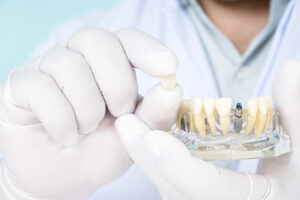
If you’re missing teeth, dental implants are one of the most natural-looking and long-lasting ways to restore your smile. But one of the first questions many people ask is, “How many implants will I need?” The answer isn’t the same for everyone. Depending on how many teeth you’re missing and where they are, you might need just one implant, a couple of them, or as many as eight. Here’s a look at the most common options.
One Missing Tooth: A Single Implant Crown
When you’re missing just one tooth, the solution is usually simple: one implant topped with a custom crown. The implant is a small titanium post that replaces the tooth’s root, while the crown is designed to match the color and shape of your neighboring teeth. Unlike a traditional bridge, it leaves the healthy neighboring teeth untouched.
If you have a few missing teeth scattered throughout your mouth, each one may be replaced with its own individual implant and crown.
Several Missing Teeth in a Row: An Implant Bridge
If you’re missing three or more teeth side by side, you don’t need an implant for every single one. Instead, an implant bridge can be anchored to two implants, one on each end. The replacement teeth in between are attached to the bridge and supported by those implants. Fewer implants can mean less time and lower cost.
Most or All Teeth Missing: Implant Dentures
For patients missing an entire arch of teeth, implant dentures offer a secure, comfortable alternative to traditional dentures. Typically, four to eight implants are strategically placed along the jaw to support a full set of replacement teeth. Implant dentures come in two main types:
- Removable implant dentures snap onto the implants and can be taken out for cleaning.
- Fixed implant dentures are permanently attached and can only be removed by a dentist.
Because implants act like natural tooth roots, implant dentures won’t slip while you eat or speak, and they help preserve the jawbone.
What Affects the Number of Implants You Need?
Even for the same type of restoration, the exact number of implants can vary from person to person. The upper jaw, for example, has softer bone than the lower jaw, so it often needs more implants for stable support. The amount of healthy bone you have, the strength of your bite, and habits like teeth grinding can all play a role, too. In some cases, a bone graft may be recommended before implants can be placed.
Your Dentist Will Help You Find the Right Fit
The best way to know how many implants you need is to schedule a consultation. Your dentist will examine your mouth, take detailed images of your jawbone, and talk with you about your goals and budget. From there, they can create a personalized plan that uses the right number of implants for you.
About the Practice
At Wolfe Dental Hillsboro in Hillsboro, Oregon, patients can complete their entire dental implant journey under one roof, from surgery to their final restoration. Dr. Ben Wolfe completed advanced implant training at the Whitecap Institute and has been placing dental implants for more than 12 years. He’s joined by Dr. Curtis Wahlen, Dr. Gabe Proulx, and Dr. Jae Lee, who all regularly pursue additional education. To find out which implant solution is right for you, call (503) 844-6550 or click here to schedule a consultation.